My certificate from the Scottish Register of Tartans is mostly empty space. There is a seal in red wax at the lower left, a signature across the bottom on behalf of the Keeper, and near the middle of the page, set in a plain serif with no ceremony whatsoever, a line that looks like a part number stamped on the underside of a machine.
DP/8 B6 LP4 B8 T6 B8 DP6 B28 DP70 Y/8
It is not a part number. Read it in the right order and it is my life.
Every block of six threads is me and my five siblings. The four is April, the month I was born. The eight is August, my anniversary. The seventy is 1970. The rest of the sequence describes how those numbers sit against one another, which is another way of saying it describes how a life is arranged.
That line is also the only part of the design Scotland holds on file. Not the purple. Not the yellow. The numbers.
What Scotland Keeps
A statutory register, and what it is actually for
The Scottish Register of Tartans was established by the Scottish Register of Tartans Act 2008 and is maintained by National Records of Scotland. It is not a club, a guild, or a heritage society. It is a public statutory register, kept by the same body that keeps Scotland's censuses and civil records.
Anyone, from anywhere in the world, can apply to record a new tartan, provided the design meets the register's criteria. Entries are organized by category: clan, family, district, corporate, military, royal. The register runs to thousands of designs and it grows every month.
What an entry records, above everything else, is threadcount. A name, a date, a designer, a category, and a string of letters and numbers describing the order in which colored threads are laid down. That string is the design. Everything else on the certificate is metadata.
A short glossary
- Sett
- The complete pattern before it starts over. A tartan is one sett repeated across the width and down the length of the cloth. If you can find where the pattern begins again, you have found the edge of the sett.
- Thread count
- The written notation of the sett. Each color gets a letter code and a number: DP70 means seventy consecutive threads of dark purple. Read the whole string and you can weave the cloth without ever having seen it.
- Pivot
- Most tartans are symmetrical, so the count is published as a half sett with pivots marked by a slash. The pattern runs to the pivot, then reflects back the way it came. A pivot is the axis of a mirror, which means whatever color sits there is the one line in the cloth that never stops repeating.
- Warp and weft
- The threads running lengthwise on the loom are the warp; those running across are the weft. In a true tartan both carry the identical sequence, which is why the pattern is square and why the blocks form where the two agree.
- Twill
- The over-and-under structure of the weave. Tartan is conventionally 2/2 twill: each thread floats over two and under two, advancing one step each pass. That step is what produces the diagonal grain you can see in any real tartan and cannot see in a printed imitation.
- Colorway
- The same sett woven in a different set of colors. A different cloth to look at and a different thing to wear, but not a different tartan. The Scottish Register of Tartans is explicit on this point: changing the shades of color used in a tartan does not create a new one. This is the term that does most of the work in this article.
- Ancient, Modern, Weathered, Muted
- Trade conventions for shade rather than categories of the register. Modern uses deep chemical dyes; Ancient lightens them to suggest older vegetable dyes; Weathered and Muted push further toward earth. The same clan tartan can appear in all four and remain, to a weaver, one tartan.
- Dress and Hunting
- Conventions of use. Dress setts lighten a ground, often to white, for formal and dancing wear. Hunting setts darken toward green and brown for daywear and the outdoors. Anyone with both has a cloth for the evening and a cloth for a Tuesday.
A Contested History
Why the system that feels ancient is mostly Victorian
Somewhere between the third cocktail and the fourth unsolicited question comes: what clan is that tartan from? I have come to accept that tartan is one of those cultural objects people feel oddly confident about while knowing almost nothing. It is right up there with astrology and wine tannins. Everyone has an opinion. Few have evidence.
The popular image of the Highlands is a parade of color-coded clans marching across the mist like an early version of Pantone. Each surname, one pattern. Each pattern, eternal. It is a beautiful lie.
Early tartan had very little interest in your last name. In the sixteenth and seventeenth centuries, patterns were regional, practical, and dependent on whatever the local weaver could coax out of moss, bark, or plant matter. You wore what your glen produced. If your neighbor shared the same hillside, chances are he shared your colors too, whether or not your grandfathers shared blood. Tartan did not signal pedigree. It signaled geography.
Then the British state panicked. The Act of Proscription received royal assent on 12 August 1746, in the aftermath of Culloden, under a title that says the quiet part out loud: an act for the more effectual disarming of the Highlands, and for restraining the use of the Highland dress. The philibeg, the trews and the plaid were prohibited along with the claymore and the dirk. Penalties ran from fines to transportation.
It is worth being precise here, because this is the part that gets exaggerated in both directions. Tartan cloth itself was not erased. Highland regiments kept it as uniform, and exceptions were made for the landed classes and their families. But for ordinary men and boys in Scotland, Highland dress was illegal for thirty-six years, and enforcement, though uneven, was real. The proscription was not repealed until 1782.
You cannot criminalize a way of dressing for a generation and a half and expect continuity to survive intact. What came back after 1782 was not a preserved tradition. It was a reconstruction. And reconstructions have a way of acquiring confidence.
By the time George IV arrived in Edinburgh in 1822, wrapped in tartan and questionable fashion decisions, the Highlands had been rebranded. Sir Walter Scott staged the visit like a national costume drama. Chiefs were expected to appear in traditional dress. Many had no clear idea what that meant. The mills, sensing opportunity, filled in the blanks. Patterns were assigned. Names were matched. Histories were smoothed over.
What emerged was a system that felt ancient because it looked ancient, and because nobody was especially motivated to interrogate it too closely. Who wants to be a party pooper. That system worked. It still works. It definitely sells kilts.
None of this is a scandal, and I am not interested in scolding anyone who wears a clan tartan. But it does change what a personal tartan is. Before tartan became a branding system, it was personal, local and adaptive. Registering my own returns to that logic without pretending the past was tidier than it was.
Adapted from my earlier essay, The Warp and Weft of Identity.
A Note on DNA, Waving a Clipboard
Why I did not simply pick one off a sept list
Biologically I am not pretending toward Scotland. My DNA profile puts me just under thirty percent Central Scotland and Northern Ireland, most of it arriving by way of my father. That is not vibes, that is data, and the surnames in the tree, Brown and Scott among them, line up neatly enough with the numbers.
But ancestry tests measure population affinity, not clan membership. They compare fragments of a genome against reference panels and return probabilities. The panels get updated. The percentages shift. Nothing about my ancestors changes. Only the math improves.
This is where people get themselves into trouble. I have Scottish DNA quietly mutates into I must belong to a clan, which metastasizes into this must be my tartan. Each step feels reasonable. Each step exceeds the evidence.
I could have taken a clan tartan from a Victorian-era sept list, one of those ingenious marketing tools that shoehorn names like Perry into larger clans, and worn it with total confidence. Plenty of people do, and they are not criminals. I registered my own instead. Not because I think I am special, but because I did not want to lie accidentally.
The Thing That Is Registered
Why a tartan can change color and stay itself
Which brings me to the part that surprises people, and to the hinge of everything that follows.
Scotland does not own the color. Scotland owns the count.
Because the registered object is a sequence of numbers, a tartan can be re-colored indefinitely without becoming structurally a different tartan. That is not a loophole. It is how the tradition has always worked. It is why a single clan sett appears as Modern, Ancient, Weathered, Dress and Hunting, and why a weaver could look at all five bolts of cloth and call them the same thing.
The register is unusually direct about this. To be recorded as a new tartan, a design has to be sufficiently different from what already exists, which the Keeper's guidance defines as a different geometry: blocks of solid color at different sizes, arranged in a new pattern, in different proportions and a new order. And then, explicitly, changing the shades of color used in a tartan does not create a new tartan.
Which means the three cloths that follow Homeplace are not new tartans and were never going to be. They are 13,909, woven differently. I will come back to what that means in practice.
What the constant sett buys is coherence. Change every color and keep the count, and the cloth still reads as the same cloth seen in different light. Someone who has seen one will recognize the others across a room without being able to say why. That recognition is structural. It is doing the work a crest does, except it is doing it in arithmetic.
The Collection
One registered sett, four cloths, 288 threads throughout
What follows is a personal tartan and its variations, not a clan or family tartan. The distinction matters on the register: a clan tartan belongs to a name, and a personal tartan belongs to a person. My entry, number 13,909, was recorded on 30 May 2023 under the name William Perry, USA (Personal). I have since derived three colorways from it. Not one of them alters a single thread of the count.
| Colorway | Subject | Register | Status |
|---|---|---|---|
| Homeplace | Family, East Tennessee, origin | Year round, day or evening | Registered, No. 13,909 |
| Midnight Formal | Washington, formal life | Evening, autumn and winter | Colorway of No. 13,909 |
| Shaconage Dress | East Tennessee, the Smokies | Ceremonial, winter and early spring | Colorway of No. 13,909 |
| Tidal Basin Spring | Washington DC, spring | Daytime, spring and summer | Colorway of No. 13,909 |
Made in Edinburgh
Kinloch Anderson, and what happens to a thread count once it leaves the register
A registered tartan is a document. It only becomes cloth when somebody weaves it, and a thread count is a set of instructions that has to be handed to people who know what to do with it. Mine goes to Kinloch Anderson.
The firm was founded in 1868 on North Bridge, in what was then Edinburgh's tailoring district, by William Anderson working with his two sons. Anderson died three years later, in 1871, and the sons, William Joseph Kinloch Anderson and Andrew Hislop Anderson, kept it going. They have kept it going ever since. It is now in its sixth generation of family ownership, led by John Kinloch Anderson, and the kilts, skirts and trews are still made to measure by hand in the company's own factory in Leith.
What Kinloch Anderson has that almost nobody else does is a century of standing with the people who would notice if the work were bad. The first Royal Warrant came from George V in 1934. A second followed from George VI in 1940. In 1955 the company was appointed Tailors and Kiltmakers to Elizabeth II, and the Duke of Edinburgh granted a warrant the year after that. The Prince of Wales granted a third in 1980. In 2024, Kinloch Anderson was among the first 145 companies to receive a Royal Warrant of Appointment from King Charles III, again as Tailors and Kiltmakers. Somewhere in the middle of all that, in 1979, they took the Queen's Award for Export, which is the less glamorous but more telling honor.
They also design tartans, and register them. Their work includes setts for Barbour, for Irn-Bru, and for the Royal Yacht Britannia, which is a range that tells you something about how the tradition actually operates in the present tense. Tartan is not a museum. It is a working system that takes commissions.
One detail I have never been able to shake. In 1890, William Joseph Kinloch Anderson gave the people of Edinburgh a stone sundial, which still stands in Inverleith Park. A family that has spent a century and a half measuring people for a living turned around and gave the city an instrument for measuring the day. I have no argument to build on that. I just like it.
What Happens Next, and a Correction
Milling in 2027, and the thing I had wrong about colorways
I have been describing the three interpretations as unregistered colorways, each of which would eventually need its own entry on the register. I was wrong, and the register is the one that says so.
The Keeper applies a test called sufficiency of difference. To be recorded as a new tartan, a design has to be substantially distinct from everything already on the register. The guidance is specific about what that means: the geometry must differ, the blocks of solid color must be of different sizes and arranged in a new pattern, and the colors must appear in different proportions and in a new order. Then it addresses my exact situation in a single sentence. Changing the shades of color used in the tartan, for example changing light blue to dark blue, does not create a new tartan.
My three interpretations keep the thread count to the thread. Only the colors move. Under the register's own rule they are therefore not new tartans, cannot be registered as such, and never needed to be.
Which turns out to be the better answer. They are not three unregistered cloths orbiting a registered one. They are 13,909, woven four ways. That is precisely how a clan tartan appears as Modern, Ancient, Weathered and Dress without any of those being separate entries. I had the principle right from the first paragraph of this article and the paperwork wrong, which is a fairly humbling way to be proven correct.
So what is actually planned for 2027 is milling rather than registration. Cloth, in three colorways, off the same registered count. If I ever did want a genuinely new register entry I would have to move the geometry, change the block sizes and the order, and at that point it would no longer be this tartan and the whole argument of this collection would collapse. The constraint is the point.
For anyone considering their own: an application to the Scottish Register of Tartans requires a thread count, a high quality color image or a woven sample of at least 18 by 23 centimetres, a proposed name, the designer and date, a rationale of up to a thousand characters, and evidence that you are entitled to use the name. There are nine categories, from Clan or Family through District, Corporate, Military, Royal, Commemorative and Fashion. The fee at the time of writing is £150. That is the whole barrier. It is lower than most people assume, and higher than a whim.
Homeplace
William Perry · East Tennessee · Origin · Registered 2023
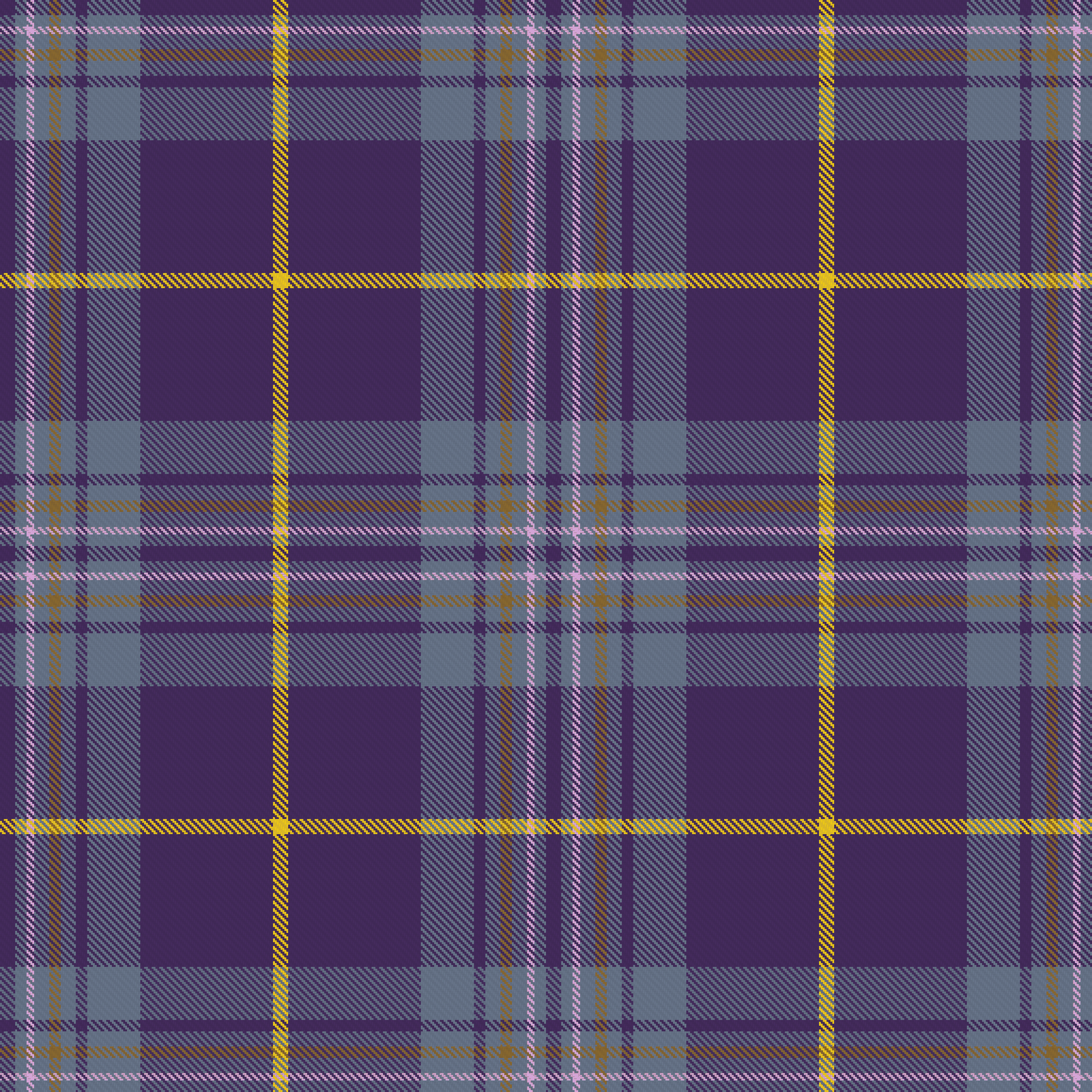
Homeplace is an American word, dated to the 1730s, meaning a person's birthplace or family home. It is not the house you live in now. It is the one you are from.
I want to be careful with the geography, because people get it wrong on my behalf. I did not grow up in Appalachia and would not claim it. I grew up in the foothills of East Tennessee, and I am a Southerner. But homeplace is the word we used, and it is the right name for a cloth whose thread count is a birth certificate.
Six threads for six children. Four for April. Eight for August. Seventy for 1970. Before a single dye was chosen, the sett already said who I was.
The colors say where. Purple for the iris, Tennessee's official state cultivated flower, and the passionflower, one of its official state wildflowers. Grey blue for the Great Smoky Mountains on the eastern horizon and for the limestone underneath them, designated a state rock in 1979. Brown for the farmland and woodland that people in that part of Tennessee actually lived on. And yellow, at the pivot, for three particular experiences of light in that country: late sun across the hills, fireflies on a summer evening, and the gold of autumn.
Because the yellow sits at the pivot, a very small quantity of thread produces a line that reappears endlessly across the cloth. It is, quite literally, a recurring thread of home.
| Color | Hex | Threads | Share |
|---|---|---|---|
| Dark Purple | #452C5E | 160 | 55.56% |
| Blue | #68758A | 100 | 34.72% |
| Light Purple | #D3A4D6 | 8 | 2.78% |
| Brown | #8A6A33 | 12 | 4.17% |
| Yellow | #E9C51B | 8 | 2.78% |
| One full sett | 288 | 100% |
Wear. Year round, day or evening. The foundation cloth, and the one I reach for when the point is simply who I am and where I am from. Weddings, christenings, funerals, Burns suppers, gatherings. 16 oz worsted for a kilt, 11 oz for sashes and ties.
Midnight Formal
William Perry · Washington · Formal life
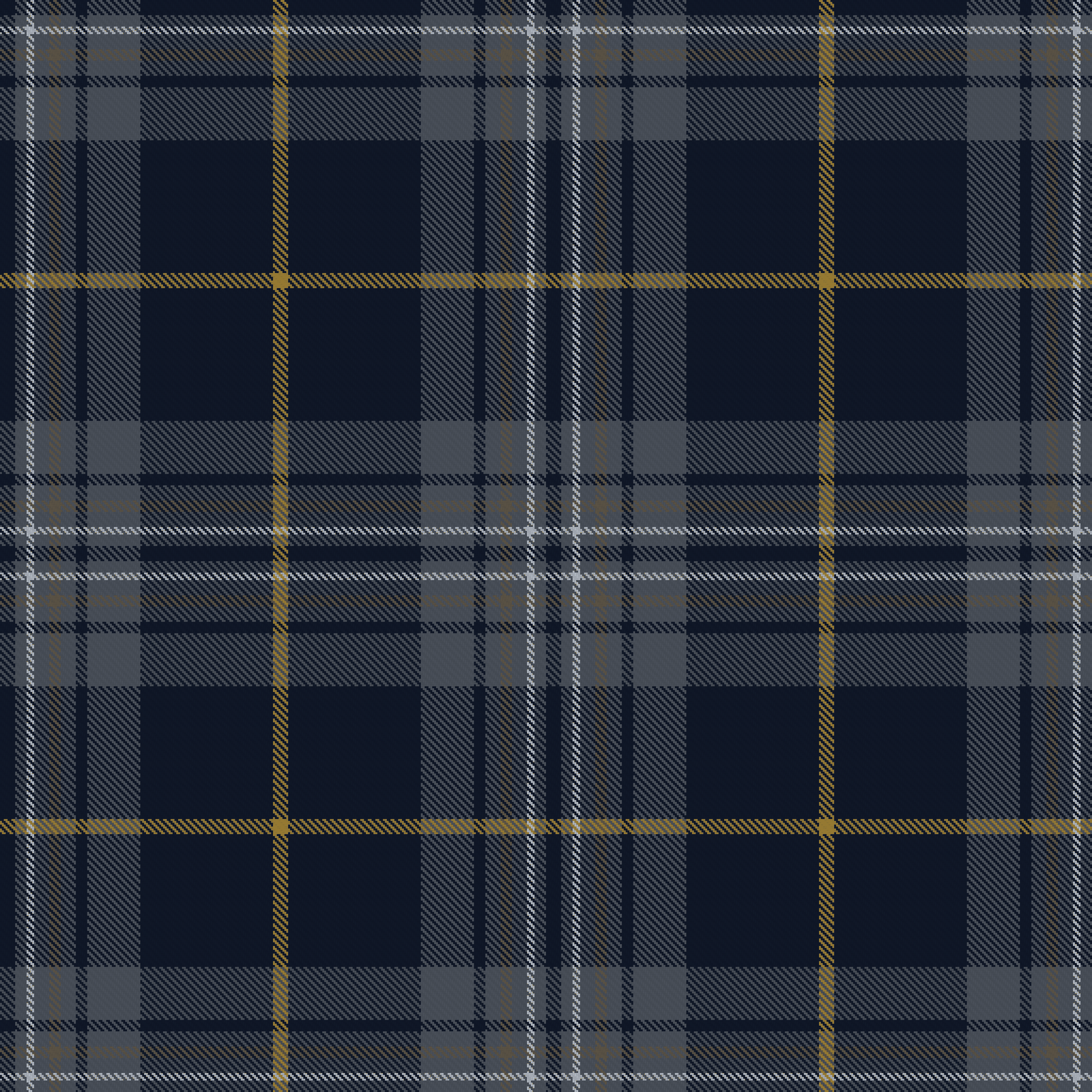
This one is not a new biography. It is Homeplace dressed for a life that happens after dark.
Midnight blue takes the ground: Washington after daylight has gone, the blue black above the monuments and embassies and ceremonial rooms where I spend a good deal of my working life. It also keeps the cool blue family of the Smoky Mountain color, which quietly ties where I live now to where I started. Charcoal grey becomes the city itself, the stone that reads pale at noon and charcoal at nine. Pale silver is the narrow business of illumination: the Potomac holding the sky, lit stone, the silver edges of the monuments.
Deep slate takes the position brown holds in the registered cloth. It is East Tennessee land, carried into a darker palette and almost invisible at conversational distance. That is deliberate. I wanted the origin in the cloth without the cloth announcing it.
And the gold. In the registered tartan, the yellow at the pivot is East Tennessee light. Here the same position becomes antique gold. The symbolism does not change so much as it ages. The light stays exactly where it was in the sett and simply turns warmer when the cloth moves into evening. Of my three interpretations, this is the only one that keeps a metallic at the pivot, which makes it the only one carrying that feature of the original forward.
| Color | Hex | Threads | Share |
|---|---|---|---|
| Midnight Blue | #101828 | 160 | 55.56% |
| Charcoal Grey | #4A505A | 100 | 34.72% |
| Pale Silver Grey | #ABB2BB | 8 | 2.78% |
| Deep Slate | #5C5449 | 12 | 4.17% |
| Antique Gold | #9C7C2A | 8 | 2.78% |
| One full sett | 288 | 100% |
Wear. Evening, autumn and winter. Black tie and white tie, formal dinners, embassy and club occasions. Reads as near black across a room and resolves into color at conversational distance. Not a daytime cloth.
Shaconage Dress
William Perry · East Tennessee · The Smokies

The National Park Service records that the Cherokee named the range Shaconage, or place of blue smoke, for the haze that hangs along the ridges. Growing up where I did, that is not scenery. It is the shape of the eastern sky.
This is the most intensely East Tennessee cloth of the four, and the only one I built to be worn to a solemn occasion in daylight. The ground comes from the blue circle of the Tennessee flag, darkened nearly to black so the tartan can function as formal dress while keeping an unmistakable origin. Smoke blue is the range itself. Ridge silver is the pale line that forms along a ridge as the haze begins to lift.
The crimson is the red field of the state flag, but it enters through East Tennessee rather than through the state at large: that flag was designed in 1905 by Captain Le Roy Reeves of Johnson City. I held it near black on purpose, so it reads dark across a room and only resolves as red in conversation. Withholding is what carries formality.
The pearl white is my favorite line in the collection. Tennessee describes its flag as three stars bound together in indissoluble unity by an unending white band. Put that white at the pivot, the axis the whole pattern reflects from, and the band genuinely never ends. It also picks up a second meaning that belongs to my family rather than the state: the same unity, applied to six siblings whose number is already written into every block of six threads. Separate members, contained in one repeating structure.
| Color | Hex | Threads | Share |
|---|---|---|---|
| Midnight | #0A0F1E | 160 | 55.56% |
| Shaconage Smoke | #4B5766 | 100 | 34.72% |
| Ridge Silver | #A6B0BB | 8 | 2.78% |
| Volunteer Crimson | #551D2A | 12 | 4.17% |
| Pearl White | #E9ECEF | 8 | 2.78% |
| One full sett | 288 | 100% |
Wear. Ceremonial, winter and early spring, correct in daylight as well as after dark. Memorial occasions, Kirkin' of the Tartan, St Andrew's Night, civic and commemorative events, winter weddings.
Tidal Basin Spring
William Perry · Washington, DC · Spring
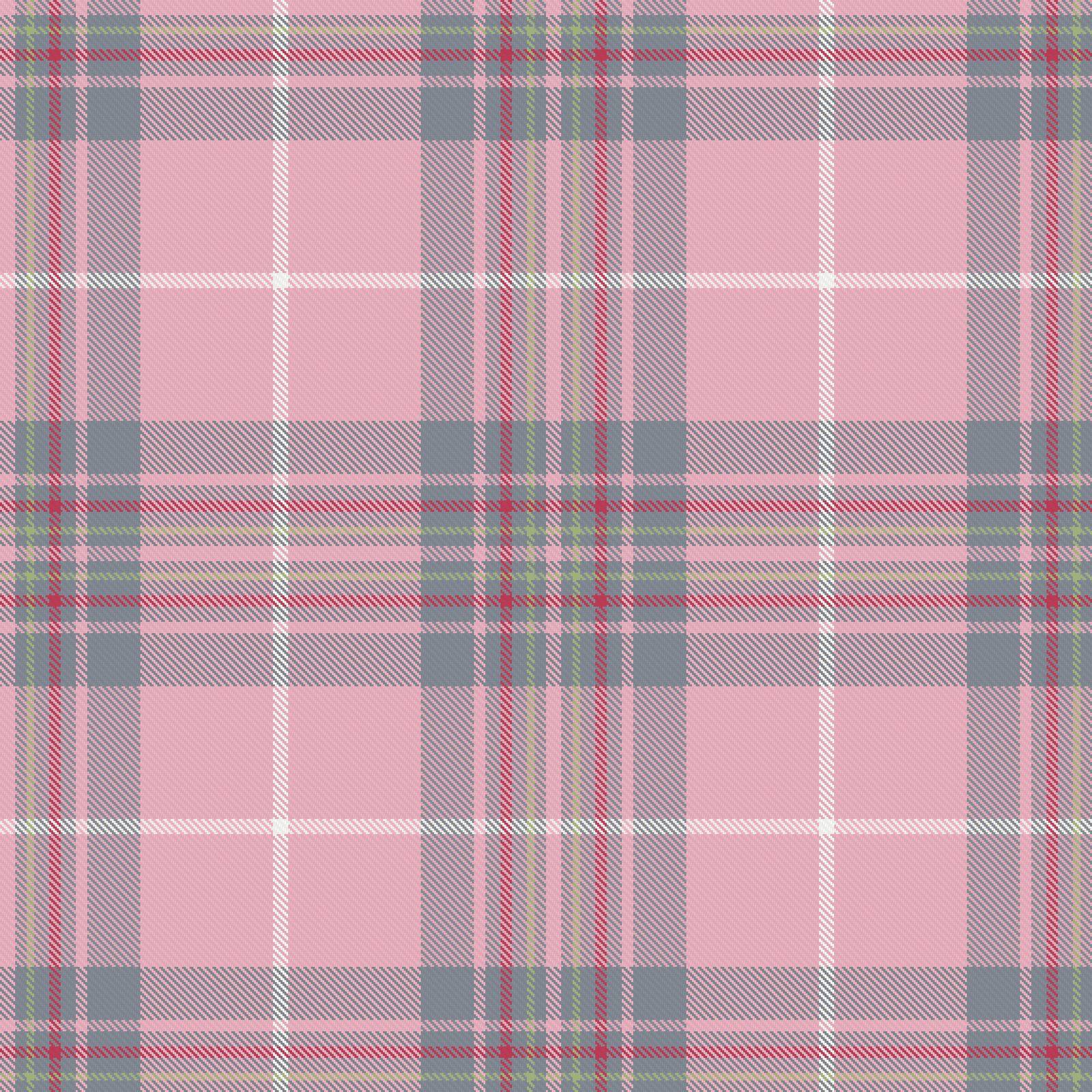
On 26 March 1912, three thousand and twenty cherry trees arrived in Washington as a gift from the City of Tokyo. The next day, Helen Herron Taft and Viscountess Chinda planted the first two on the north bank of the Tidal Basin. Eighteen hundred of the trees were Somei-Yoshino, which is the reason this cloth is pink rather than white.
If Homeplace is where I started, this is where I live now. Blossom pink takes the largest block in the sett, so blossom becomes the atmosphere of the cloth rather than a stripe running through it. Monument grey is the Washington the trees are actually seen against, because blossom is almost never seen in isolation. It is seen against marble, granite, water and sky. The grey does here exactly what the Smoky Mountain color does in the registered tartan: it names the place beneath the season.
The green is deliberately muted toward mature foliage rather than a traditional tartan green, because the Washington I know is not only the federal city of stone. It is a remarkably green one: the Mall, Rock Creek Park, the street trees, the banks of the Potomac. And the soft cherry is the District flag, three red stars above two red bars taken from the arms of George Washington, softened so the city can be present politically without a primary red cutting through spring.
Then there is the white at the pivot, which carries the flag's white ground and the pale edge of a Yoshino petal, and one more thing besides. The pivot is inherited. It is the point where the pattern turns back on itself and starts again, and it does not move no matter what colors surround it. East Tennessee can become Washington. Purple can become pink. Yellow can become white. The structure underneath does not change.
| Color | Hex | Threads | Share |
|---|---|---|---|
| Blossom Pink | #F0B6C4 | 160 | 55.56% |
| Monument Grey | #868E97 | 100 | 34.72% |
| Foliage Green | #9FBC7A | 8 | 2.78% |
| Soft Cherry | #C0405A | 12 | 4.17% |
| Blossom White | #FCFCFA | 8 | 2.78% |
| One full sett | 288 | 100% |
Wear. Daytime, spring and summer. Daytime weddings, garden parties, Cherry Blossom Festival events, outdoor occasions. 11 oz or 13 oz worsted; a heavy 16 oz would fight the season.
The Rule
What keeps a collection from becoming a color exercise
Four cloths off one sett could easily be four moods. What stops that is a rule I applied to every position in the count. Each of the five slots carries the same kind of meaning in every colorway, and no color is in there because it looks well. Each has to earn its place through biography, family, or geography.
| Position | Share | What it carries |
|---|---|---|
| Ground | 55.56% | The dominant place or atmosphere |
| Second field | 34.72% | The landscape or built environment |
| Fine line | 2.78% | A secondary feature of that landscape |
| Guard line | 4.17% | A specific civic, historical or family reference |
| Pivot | 2.78% | Continuity, light, unity, the connective idea |
Read that against the four and each resolves into a single sentence. Homeplace is East Tennessee remembered. Midnight Formal is that life carried into evening. Shaconage Dress is East Tennessee made ceremonial. Tidal Basin Spring is my present home expressed through its most distinctive season.
DP/8 B6 LP4 B8 T6 B8 DP6 B28 DP70 Y/8 · half sett, full count at pivots · 288 threads per full sett · 2/2 twill
The Block That Is Still Empty
Twenty-eight threads, undesignated
Go back to the count one more time. Six is my siblings. Four is April. Eight is August. Seventy is 1970. There is one block left over, and I never decided what it meant.
Twenty-eight threads of blue, sitting immediately against the seventy. It is the second largest block in the sett and the only slot in the whole design still available to record something.
The obvious candidate is a day. The count names two months and gives no dates, which is a specific and visible gap in an otherwise complete statement, and the twenty-eight sits directly beside the year. Whoever fills it would not be assigning a meaning so much as noticing one.
Or it stays empty, and I am increasingly convinced that is the better answer. A personal tartan with one undesignated block is a cloth that is not finished, which is the correct posture for a life still being lived. It is the natural place to record whoever comes next. Reserving it says more than filling it.
Either way, the arithmetic will not change. That is the point of putting a life into numbers and sending them to Edinburgh. The colors can go anywhere. The count stays where it is.
Questions People Ask
Usually somewhere around the third cocktail
- What does the Scottish Register of Tartans actually register?
- The thread count. The register was established by the Scottish Register of Tartans Act 2008 and is maintained by National Records of Scotland. An entry records a name, a date, a designer, a category, and the sequence describing the order in which colored threads are laid down. The color values themselves are not the registered object.
- Can a registered tartan be woven in different colors?
- Yes, and the result is still the same tartan. Because the registered object is a sequence of numbers, a sett can be re-colored indefinitely without becoming a different tartan. That is how one clan sett appears as Modern, Ancient, Weathered, Dress and Hunting without any of those being separate register entries. The Keeper's guidance says so directly: changing the shades of color used in a tartan does not create a new tartan.
- What is the difference between a sett and a colorway?
- The sett is the structure, meaning the pattern and its thread count. A colorway is that same structure woven in a different set of colors. Change every color and keep the count and it is still, to a weaver, the same tartan.
- Are clan tartans really ancient?
- Mostly not, at least not in the form we know them. Early tartan was regional rather than hereditary. Highland dress was then prohibited from 1746 until 1782, and much of the clan-to-pattern system we recognize today was assembled in the decades after that, particularly around George IV's 1822 visit to Edinburgh. The tradition is real. Its tidiness is Victorian.
- What is the thread count of this tartan?
- DP/8 B6 LP4 B8 T6 B8 DP6 B28 DP70 Y/8, given as a half sett with full count at pivots. Expanded and reflected, that is 288 threads per full sett, woven 2/2 twill.
- Which of the four colorways is registered?
- All of them, in the sense that matters. There is one register entry, No. 13,909, recorded as William Perry, USA (Personal). Midnight Formal, Shaconage Dress and Tidal Basin Spring share its thread count exactly, so under the register's rules they are that same tartan in different colors rather than three additional tartans awaiting registration.
- What does homeplace mean?
- It is an American word dating to the 1730s, meaning a person's birthplace or family home. Not the house you live in now, the one you are from.
- Can I have a tartan designed and registered?
- Yes. Anyone, from anywhere in the world, can apply to record a new tartan with the Scottish Register of Tartans provided the design meets its criteria. You do not need Scottish ancestry and you do not need a clan.
Notes and sources
- Scottish Register of Tartans, certificate of registration no. 13,909, William Perry, USA (Personal), 30 May 2023, issued on behalf of the Keeper of the Scottish Register of Tartans, National Records of Scotland. Entry no. 13,909 on the Scottish Register of Tartans
- Scottish Register of Tartans Act 2008; register maintained by National Records of Scotland.
- Act of Proscription 1746: royal assent 12 August 1746, prohibiting the philibeg, trews and plaid along with Highland weapons, with exceptions for Highland regiments and for the landed classes and their families; penalties from fines to transportation; repealed 1782. The History of Parliament, A Farewell to Arms, Kilts and Sporrans
- State of Tennessee, State Symbols. Iris, genus Iridaceae, official state cultivated flower, purple by common acceptance; Passion Flower, genus Passiflora, an official state wildflower; limestone designated a state rock in 1979; the state flag described as three stars bound together in indissoluble unity by an unending white band. tn.gov
- National Park Service, Great Smoky Mountains National Park: the Cherokee named Shaconage, or place of blue smoke. nps.gov
- Tennessee Historical Society, History of the Tennessee State Flag: designed in 1905 by Le Roy Reeves of Johnson City, captain of the Third Regiment, Tennessee Infantry, National Guard. tennesseehistory.org
- National Park Service, History of the Cherry Trees: 3,020 trees of twelve varieties from the City of Tokyo, arrived 26 March 1912; first two planted 27 March 1912 by Helen Herron Taft and Viscountess Chinda; 1,800 Somei-Yoshino. nps.gov
- Government of the District of Columbia, DC Symbols: flag approved 25 October 1938, three red stars above two red bars on a white background, from the coat of arms of George Washington. os.dc.gov
- Homeplace, a person's birthplace or family home; an Americanism dating to 1730–40. Dictionary.com
- Kinloch Anderson: founded 1868 on North Bridge, Edinburgh, by William Anderson with his two sons; continued from 1871 by William Joseph Kinloch Anderson and Andrew Hislop Anderson; sixth generation of family ownership; manufacturing in Leith; Royal Warrants from George V (1934), George VI (1940), Elizabeth II as Tailors and Kiltmakers (1955), the Duke of Edinburgh (1956) and the Prince of Wales (1980); Queen's Award for Export (1979); Royal Warrant of Appointment from King Charles III (2024); stone sundial given to Edinburgh in 1890, still in Inverleith Park. kinlochanderson.com and the Royal Warrant Holders Association
- Scottish Register of Tartans, sufficiency of difference: "The geometry of your design must be different, ie. the blocks of solid colour must be of different sizes and arranged in a new pattern. Your tartan will use different colours in different proportions and in a new order," and changing the shades of colour used in a tartan "will not create a new tartan." Registration requirements and the £150 fee are set out in the register's guidance notes. tartanregister.gov.uk
- The history section is adapted from my earlier essay, The Warp and Weft of Identity.
- Midnight Formal, Shaconage Dress and Tidal Basin Spring are color variations of registration 13,909 rather than separate tartans. Under the Scottish Register of Tartans guidance on sufficiency of difference, a change of color alone does not create a new tartan, so they are neither separately registered nor separately registrable. None is an official emblem of the State of Tennessee, the District of Columbia, the National Park Service, the Eastern Band of Cherokee Indians, or the Cherokee Nation, and no endorsement by any of them is claimed or implied.